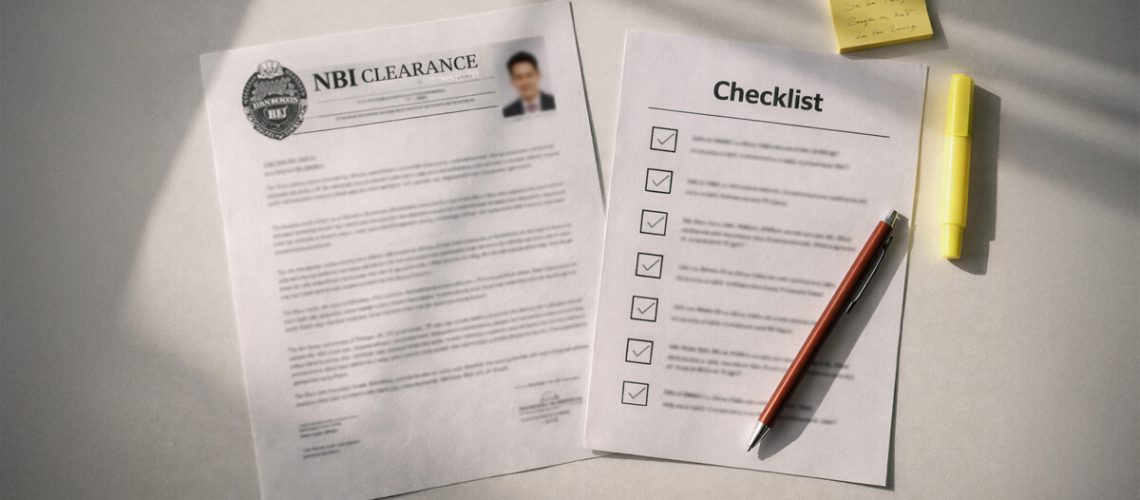
Every HR team in the Philippines knows the NBI clearance. It is the first thing candidates submit, the easiest box to tick, and the most commonly misunderstood document in the pre-employment process.
Here is what most organizations do not realize: an NBI clearance is a snapshot, not a complete picture.
What an NBI clearance actually confirms
An NBI clearance confirms that, at the time of issuance, the candidate has no pending derogatory record in the National Bureau of Investigation’s database. That is it. The clearance does not cover records that were filed after the issuance date. It does not cover cases that were dismissed, withdrawn, or settled out of court. It does not include records from the Regional Trial Court or Municipal Trial Court systems, which operate separately from the NBI database. And it does not cover civil cases, administrative proceedings, or regulatory violations outside the NBI’s jurisdiction.
A candidate can hold a valid NBI clearance and still have a pending court case, a history of dismissed fraud charges, or a regulatory violation on record with a government agency. None of these would appear on the clearance document.
Where the gaps show up in practice
The most common scenarios where NBI-only screening fails Philippine organizations involve three situations.
The first is the candidate who was charged and later acquitted or had a case dismissed. The NBI database updates to reflect the resolution, but the history of the charge, the nature of the allegation, and the circumstances of the dismissal are not visible in the clearance result.
The second is the candidate with a pending civil or labor case filed in the regular court system. RTC and MTC records are not integrated into the NBI database. A candidate involved in an ongoing labor dispute with a previous employer, for example, would receive a clean NBI clearance.
The third is the candidate whose clearance was issued before a case was filed. NBI clearances are valid for one year. A candidate who obtained their clearance eleven months ago could have had a case filed against them in the intervening period.
What this means for your hiring process
For roles with low access and low consequence, NBI-only screening may be acceptable. An entry-level support role with no access to financial data, customer information, or physical assets carries a different risk profile than a finance manager, a system administrator, or a senior operations leader.
For any role with access to funds, sensitive data, customer accounts, or approval authority, NBI clearance alone is not sufficient. These roles require supplemental verification: RTC and MTC court records searches, employment history verification with previous employers, and, for compliance-regulated industries, additional watchlist and database checks.
A practical rule for Philippine HR teams
Before every hire, ask one question: if this person had a history we did not know about, what damage could they do from this role? The answer tells you how far beyond the NBI clearance you need to go.
Vanguard background checks go directly to the sources that the NBI does not cover. If you want to understand what a role-based screening package looks like for your specific hiring needs, message us for a free consultation.